PHP Vulnerability Today: What You Need to Know
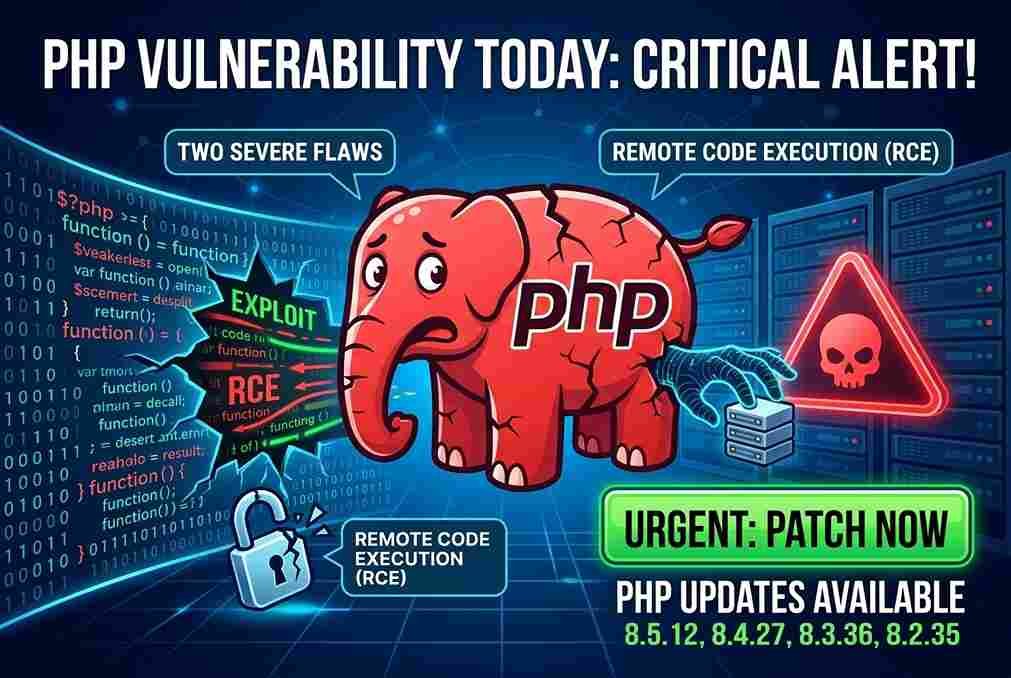
PHP vulnerability today is a big story. Two flaws hit PHP this week. As a result, many sites need a fix now. Both flaws let hackers run code on a server. So, this guide keeps things short and clear. First, you will see the latest news. Then, you will learn what to do.
PHP Vulnerability Latest News
The PHP team sent an alert on October 20. It warned of two severe flaws. A day later, the team shipped fixes. Reports say leaked facts sped up the release. Thus, admins had little time to plan.
The flaws have IDs. They are CVE-2026-109618 and CVE-2026-109619. Each one scores 9.2 out of 10 on the CVSS v4.0 scale. That is a top rating. In other words, it is as bad as it gets.
Here is the news in brief:
- The PHP team released fixes on October 21, 2026.
- Both flaws can let hackers run code from afar.
- Hackers do not need a login.
- Public test code for the attack now exists.
- Security firms added new ways to spot attacks.
Also, neither flaw was on the CISA list of known attacks at last check. Yet that can change fast. So, check the list again.
Quick Timeline
- October 20: The PHP team warns of two flaws.
- October 21: Fixed versions go live.
- Around the same time: Test attack code circulates online.
- Since then: Hosts and tool makers push new builds.
What Is PHP?
PHP is a free coding language. It runs on web servers. When you visit a page, PHP often builds it. For example, WordPress uses PHP. So do many shops and forums. Because of this, PHP powers a huge part of the web. Thus, one PHP flaw can touch millions of sites.
Also, PHP is old and trusted. Many firms have used it for years. But age brings risk. Old code can hide old bugs. That is why patches matter.
PHP Vulnerability Explained
What the Flaws Do
A flaw is a weak spot in code. Hackers can use it to do harm. These two flaws sit in the PHP core. In other words, they are not in a plug-in. Canada’s Cyber Centre says both are use-after-free bugs. That means PHP uses a piece of memory after it frees it. As a result, a hacker may take over that spot. Then, the hacker can run code on your server. Experts call this remote code execution, or RCE.
One flaw links to out-of-memory errors. The other links to stale state. Still, both lead to the same end.
How Hackers Could Use Them
The steps are not hard to grasp. First, a hacker sends a bad web request. Next, the server tries to handle it. Then, the bug fires. Last, the hacker gains a foothold. After that, the hacker can try more harm.
Note that no login is needed. So, any site on the web can be a target.
Who Is at Risk
Most default PHP setups are exposed, early reports say. The risk is highest with mod_php. In that setup, a request can trigger the bug early. It can happen before your own code runs. Also, public sites face more risk than inside ones. Still, inside systems should not wait.
PHP Vulnerability Update: Fixed Versions
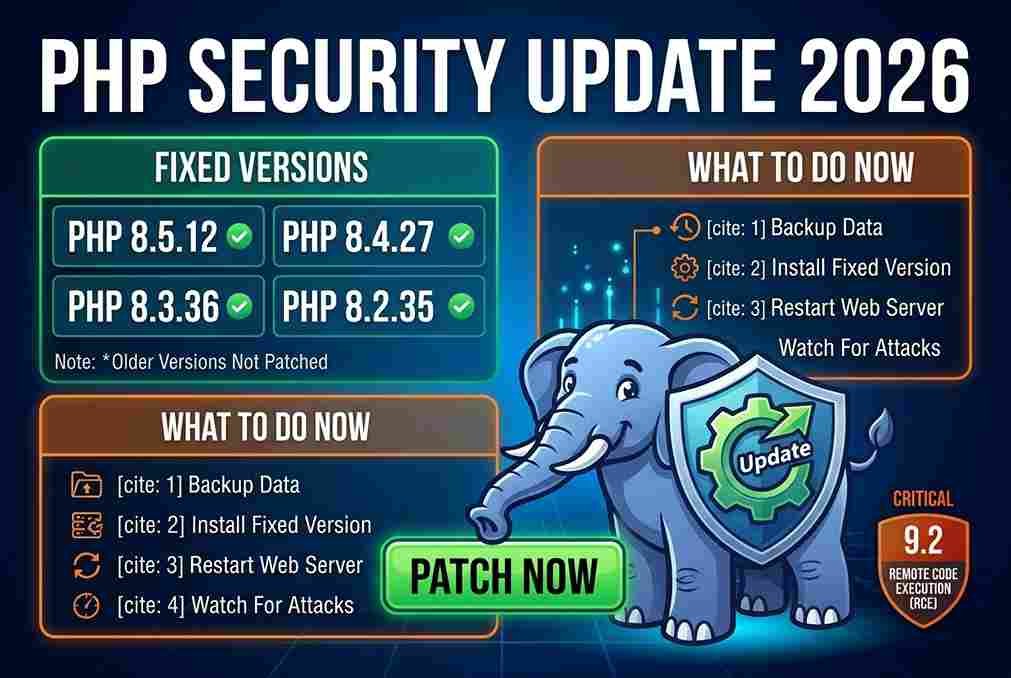
The fixes came in four releases. Here is the list:
| PHP Branch | Fixed Version |
|---|---|
| 8.5 | 8.5.12 |
| 8.4 | 8.4.27 |
| 8.3 | 8.3.36 |
| 8.2 | 8.2.35 |
| 8.1 and older | No fix. Upgrade. |
Older lines got no fix. For instance, PHP 8.1 is past its end of life. Also, PHP 8.2 ends its support on December 31, 2026. So, plan a move to a newer branch. Plus, one research firm thinks very old lines are hit too.
Many hosts ship patched packages as well. For instance, Docker images and Linux distros now have updates. Ubuntu said it may port the fixes back to older builds. So, your host may patch for you. Still, always check.
PHP Vulnerability Issue: Why It Is Serious
Why does this matter? First, hackers need no password. Second, they can run commands on your server. Third, test code for the attack is now online. Thus, bots may scan for weak sites soon. Plus, some reports say sites went offline as teams rushed to patch.
Also, PHP says no full workaround exists. In short, patching is the only safe path.
What Could Go Wrong
If you skip the patch, the risks are real. For instance, hackers could steal data. They could also plant bad files. Next, they could use your server to hit other sites. Last, they could lock you out and ask for cash. So, a quick fix saves a lot of pain.
How to Stay Safe
Follow these steps:
- Find every PHP site and app you run.
- Check the PHP version on each one.
- Update to 8.5.12, 8.4.27, 8.3.36, or 8.2.35.
- Restart the web server after the update.
- Watch your logs for odd acts.
Next, think about a stopgap if you cannot patch yet. Early advice said to turn off session.upload_progress.enabled. Yet this only helps in part. Thus, it is no match for the patch.
Meanwhile, watch for strange child tasks. For instance, a web server that starts a shell is a red flag. Likewise, huge uploads that end in errors may signal an attack.
Tips for Shared Hosting Users
You may not own the server. In that case, ask your host two things. First, ask if the host has patched PHP. Second, ask which version your site now uses. Also, switch to a safe version in your panel if you can. Then, test your site.
Tips for Teams
If you run many servers, make a list. Then, rank the list by risk. For example, start with public sites. After that, do the rest. Finally, write down what you did.
FAQ
Is the PHP vulnerability today still a risk?
Yes. Fixes exist, but sites without them stay at risk. So, update now.
Which PHP versions fix the flaws?
Use 8.5.12, 8.4.27, 8.3.36, or 8.2.35. Older lines have no fix. Thus, move to a new branch.
Can a workaround stop the attack?
Only in part. PHP says updating is the only safe choice. So, do not rely on a stopgap.
Does this affect WordPress sites?
Yes, if the server runs an old PHP. But you fix it on the server, not in WordPress. So, ask your host.
Where can I find the latest news?
Visit php.net for the official notes. Also, watch your host and your Linux distro. Both post new facts often.
Conclusion
The PHP vulnerability today is serious. Two severe flaws let hackers run code from afar. Yet fixes are out. In short, update to a patched version now. Also, check php.net for news, since this story may change. Finally, plan to leave old versions soon.